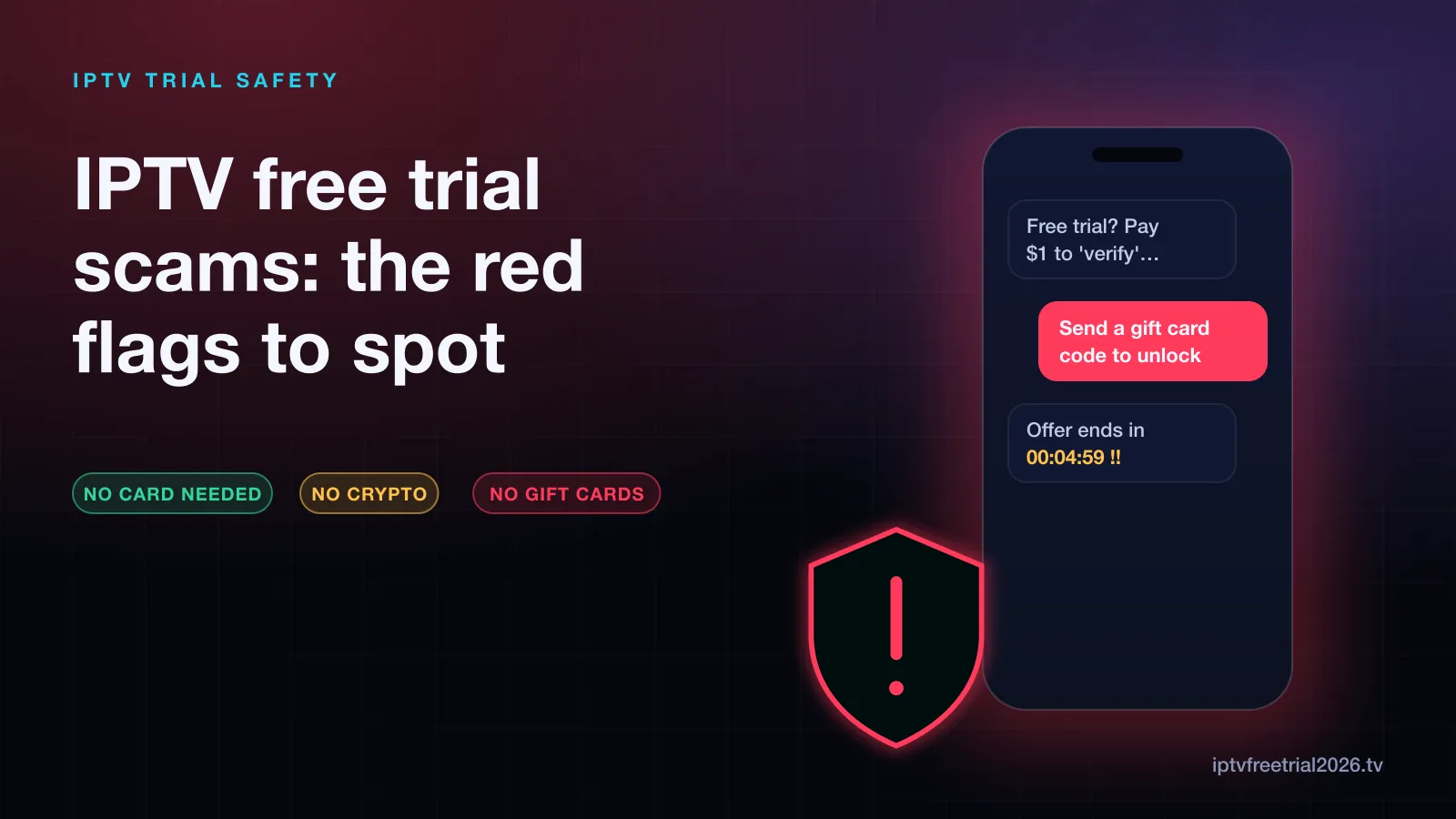
How do you spot IPTV free trial scams?Nearly every fake trial asks you to pay for something it calls free — a card "for verification", a $1 unlock fee, crypto or a gift card code. Add resetting timers, lifetime deals, lookalike website names and no way to reach a person, and you have the full pattern. A genuine trial stores no payment details and simply ends. Ours is a 24-hour trial over WhatsApp with no card at all.
Why the IPTV trial market attracts scams
IPTV is sold mostly online, by small operators, often over chat apps rather than through app stores. There is no central marketplace with refunds and seller ratings, so the usual safety net is missing. That makes the free trial the moment of maximum trust: you are about to hand a stranger an email address, a phone number and sometimes a payment method, on the strength of a website you found ten minutes ago. Scammers know this and build the trial itself into the trap.
The good news is that scams repeat. The same handful of tricks shows up again and again, and once you know them they are easy to see. Here are the nine that matter.
The 9 red flags
1. A payment step for something called free
A "small verification charge", a $1 activation fee, or a card required "just to confirm you are real". A trial that needs a payment is either a subscription with a delay or a way to harvest card details. Either way, the free part is the bait. If you want the longer explanation of why card-required trials exist, read why some IPTV trials ask for a card.
2. Crypto or gift cards
Requests to pay in crypto or with a gift card code are the single strongest warning sign on this list. Both are close to impossible to reverse, which is the whole point. No legitimate seller needs a gift card code to send you a trial login. Walk away.
3. Timers that reset and fake scarcity
Pressure is a substitute for proof. A timer that resets every time you reload the page, or a counter of remaining slots for a digital product with no stock limit, exists to stop you from checking anything else on this list.
4. Lifetime and multi-year deals
"Lifetime access for $49" is a promise that depends on a small operator still being in business years from now. Even honest services cannot guarantee that. Scammers sell these deals because the money arrives up front and complaints arrive much later.
5. A website that borrows someone else's name
Lookalike domains copy a known provider's name with a hyphen, an extra word or a different ending. Before you sign up, compare the address in your browser with the one in the link you meant to follow, and search the brand name to see whether more than one site claims it.
6. Reviews and ratings you cannot trace
Five-star badges, crowd-size banners and glowing testimonials with no names, dates or links are decoration, not evidence. Look for discussion on forums you already trust, written by accounts with a history. If the only praise for a provider lives on its own website, treat it as advertising.
7. No way to reach a human
A genuine provider answers questions before you pay, because that is how it wins customers. Send one simple question — what happens when the trial ends? — and time the reply. Silence, a bot loop or a reply that only repeats the price tells you what support will look like after you have paid.
8. Requests for more access than a login needs
A trial needs, at most, a way to send you login details. It never needs ID documents, remote control of your device, or an app that asks for contacts, SMS or accessibility permissions. If installing the "player" means granting permissions unrelated to playing video, cancel the install.
9. A demo dressed up as a trial
A single test stream, a locked channel list or a two-hour window at midday is a preview. It cannot show you what you would actually be paying for — the full lineup, the guide, the VOD library and how streams hold up between 7 and 10pm. A short, cut-down trial is not always a scam, but it hides exactly the things you need to see.
A ten-minute check before you sign up
- Read the end-of-trial terms. Find, in plain words, what happens when the window closes. If you cannot, assume automatic billing.
- Check the payment step. If starting the trial looks like a checkout, stop.
- Check the domain. Make sure it matches the brand, and search for duplicates.
- Ask one question. Time the reply and judge whether a person wrote it.
- Read the refund policy. It should exist, be specific and match what the sales pages promise. Ours is on the refund policy page.
Once you are in, run a structured test rather than channel-surfing. Our 24-hour IPTV trial checklist sets out what to check and when, and it works on any provider — including us.
The legal side, briefly
Scams and legality are separate questions. A provider can be perfectly prompt and still carry channels it has no rights to, and an unlicensed service can vanish overnight if it is shut down — which is one more reason not to prepay for long plans. The rules differ by country; our guide to whether IPTV is legal covers the basics.
If you have already paid
- Card payment: contact your card issuer the same day and ask about a chargeback. Cancel the card if it was stored.
- PayPal and similar: open a dispute inside the payment app; time limits apply.
- Crypto or gift cards: report it to the gift card issuer or exchange, but expect that the money may be gone.
- Passwords: if you reused a password on the site, change it everywhere you used it.
- Apps: uninstall anything the provider asked you to install outside an app store.
How our trial measures up
We sell IPTV, so you should check us against this list too. Our trial runs on WhatsApp, asks for no card and no payment of any kind, and gives full access to channels, VOD and the guide for 24 hours. When it ends, access stops; there is nothing to cancel. If you decide to subscribe, plans are on the pricing page. For how other providers handle trials, see our comparison of IPTV free trial services in 2026.
Frequently asked questions
How can I tell if an IPTV free trial is a scam?
The clearest sign is a payment step attached to something called free — a card, a small "verification" charge, crypto or a gift card code. Other warning signs are resetting timers, lifetime deals, no way to reach a person and a website that copies another provider's name.
Is it safe to give my email or phone number for an IPTV trial?
A contact detail is normally needed to send you login details, and that is reasonable. Be wary when a provider asks for more than it needs — ID documents, card numbers or remote access to your device are never required to deliver a trial login.
What should I do if I paid for a fake IPTV trial?
Contact your card issuer or payment provider straight away and ask about a chargeback, and cancel the card if it was stored. Gift cards and crypto are rarely recoverable, which is exactly why scammers ask for them. Change any password you reused on the site.
Are free IPTV trials ever genuinely free?
Yes. A genuine trial starts with no payment details stored anywhere, gives you the real channel list, VOD and guide for a fixed window, and simply stops when the window ends. There is nothing to cancel because nothing can be charged.